
It Needs Fewer Broken Processes.
By Debadutta Rath | Chief Innovation Officer, SVARAPPS Technologies · October 15, 2026
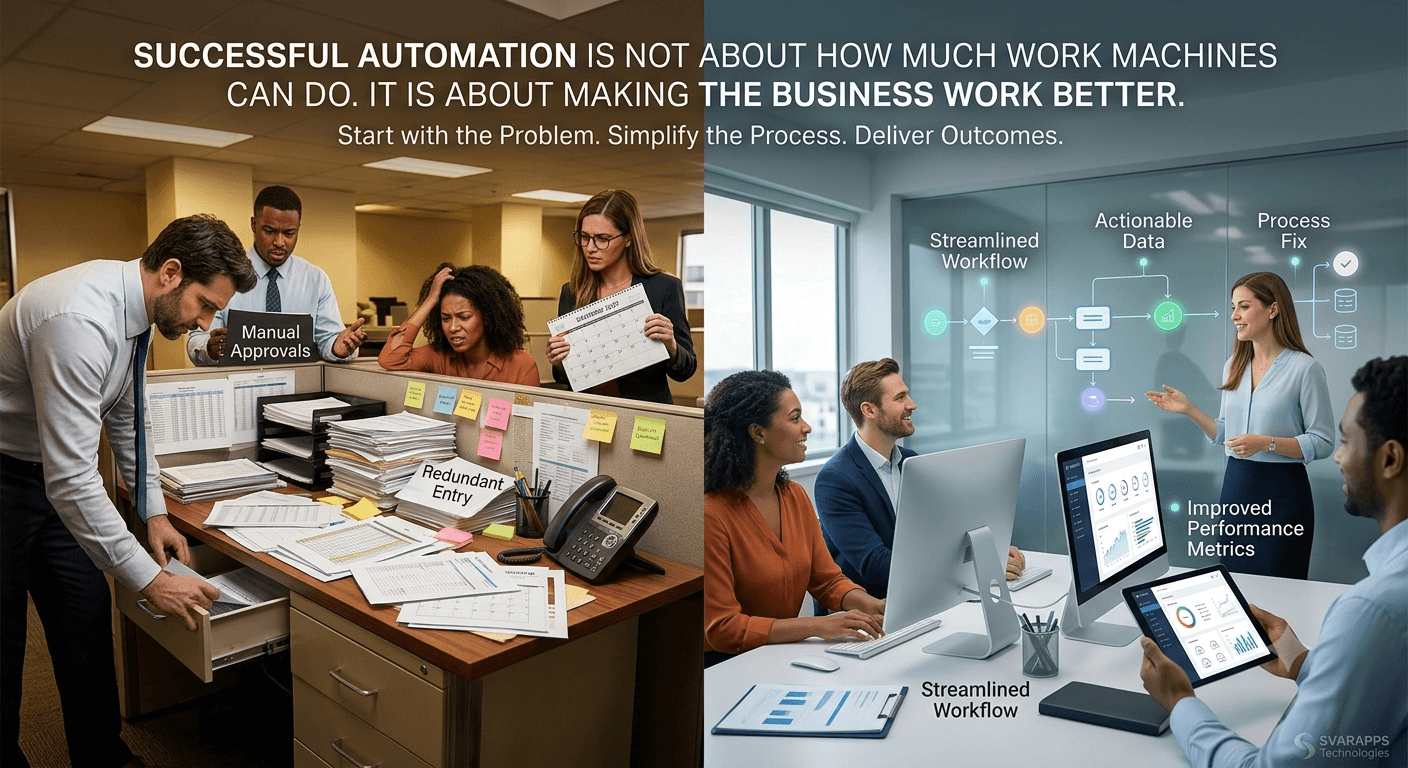
There is something I have observed repeatedly in enterprise technology: organisations invest in automation to save time, reduce manual effort and improve productivity, yet their employees continue to spend a surprising amount of time chasing approvals, correcting errors, reconciling data and working around the very systems that were supposed to make their lives easier. The technology is often doing exactly what it was designed to do. The problem is that nobody stopped to question the process itself. We have become very good at automating tasks. But have we become equally good at eliminating unnecessary work? I believe this is one of the most important questions organisations need to ask as they rethink their automation strategies.
When automation becomes an expensive workaround
Consider a familiar business scenario. An employee receives a customer request, enters the details into one application, copies the information into another system, sends an email for approval and updates a spreadsheet to track progress. Another employee checks the spreadsheet, follows up with the approver and eventually updates the original application. Now imagine automating each of these steps. The data gets copied faster. Emails are triggered automatically. The spreadsheet updates without human intervention. Notifications are sent on time. The process is faster, certainly. But it is still a fragmented process with multiple hand-offs, duplicated information and unnecessary dependencies. We have improved the mechanics without improving the underlying design. This is where organisations need to rethink their approach. Automating a broken process does not necessarily fix it. Sometimes, it simply allows the broken process to operate at a greater speed and scale. The real opportunity is to ask why the information needs to be entered multiple times, why the approval follows that particular route, why the spreadsheet exists in the first place and whether the entire workflow can be redesigned around the desired business outcome. Only then does automation become a tool for transformation rather than a mechanism for preserving old habits.
The difference between doing work faster and eliminating work
Not all automation creates the same kind of value. At the simplest level, task automation removes repetitive human actions. A report is generated automatically, a notification is sent or a document is processed without manual intervention. This is useful. These improvements can free up time and reduce errors. Process automation goes further by connecting activities across a workflow. Instead of automating isolated steps, it coordinates how information, decisions and tasks move between people and systems. Business transformation asks a more fundamental question: does the process need to exist in its current form at all? These are different levels of thinking, and organisations need all three. Sometimes, a small automation is exactly the right solution. There is no reason to redesign an entire enterprise process simply to eliminate a repetitive task. But when a workflow contains multiple hand-offs, recurring exceptions, duplicate data entry and persistent delays, automating individual steps may only address the symptoms. The challenge is knowing when to automate a task, when to redesign a process and when to eliminate an unnecessary activity altogether. That decision should be driven by business value, not by the availability of a particular tool.
The technology is not the strategy
The automation landscape has expanded considerably. Robotic Process Automation (RPA) can handle repetitive interactions with applications. APIs allow systems to exchange information directly. Workflow platforms coordinate tasks, approvals and business rules. Process mining can help identify bottlenecks from operational data. Artificial intelligence can assist with unstructured information, classification, interpretation and decisions that are difficult to express through fixed rules. These capabilities are complementary, but they are not interchangeable. A stable, rule-based process may be best served by conventional workflow automation. A legacy application without suitable integration interfaces may require RPA. A document-heavy process may benefit from AI-assisted extraction and validation. A complex process spanning several enterprise applications may require a combination of APIs, workflow orchestration and human approvals. The question should never be, "How can we use this technology?" It should be, "What is preventing this business process from delivering the outcome we need, and what is the simplest reliable way to remove that constraint?" Technology selection should follow that assessment. The most sophisticated solution is not always the best solution. Reliability, maintainability, security and the total cost of ownership matter just as much as technical capability.
Why data and integration determine the real outcome
Many automation initiatives encounter difficulties because the organisation focuses on the workflow but overlooks the information moving through it. Customer records differ between systems. Product information is inconsistent. Reference data is incomplete. Applications use different identifiers. Employees compensate for these gaps by manually checking and correcting information before proceeding. An automated process can move data quickly, but it cannot automatically make unreliable source data trustworthy. This is why integration and data quality are foundational to effective automation. Organisations need to understand which system owns each piece of information, how systems communicate, how errors are handled and what happens when a dependency becomes unavailable. They also need to design for exceptions. Real business processes rarely follow the ideal path every time. Payments are disputed, documents are incomplete, approvals are delayed and systems occasionally fail. A good automation strategy accounts for these situations rather than assuming they will not occur. The goal is not to remove every human interaction. It is to reserve human attention for the situations where judgment, investigation or accountability genuinely matters.
AI is changing the automation conversation
Artificial intelligence introduces another dimension to automation. Traditional automation generally works best when the rules, inputs and expected outcomes are well defined. AI can help when information is unstructured, context matters or a process requires interpretation. For example, an invoice-processing workflow may already extract fields and validate amounts through conventional automation. AI could help classify supporting documents, summarise discrepancies or identify information that requires further investigation. Similarly, an IT operations workflow might use fixed rules to detect a threshold breach while AI helps correlate incident information, summarise likely causes and recommend troubleshooting steps. Agentic AI extends this possibility further by allowing systems to plan and execute sequences of authorised actions towards a defined objective. However, greater capability also introduces greater responsibility. AI-generated outputs can be incorrect. An agent may misinterpret context or take an inappropriate action if its permissions and decision boundaries are poorly designed. Organisations must therefore establish appropriate access controls, validation mechanisms, audit trails and human approval points. Not every workflow needs AI, and not every AI-enabled workflow should be autonomous. The objective is to combine deterministic automation, AI and human judgment in a way that is appropriate to the business problem and its associated risks.
Measure the value, not the number of bots
One of the easiest ways to misjudge an automation programme is to measure success by counting how many processes have been automated or how many bots have been deployed. These metrics tell us something about implementation activity. They do not necessarily tell us whether the business is better off. A more meaningful assessment begins with the original problem. How long did the process take before automation? How frequently did errors occur? How much rework was required? Where were the delays? How many hand-offs were involved? What was the operational cost? After implementation, the same measures can help determine whether the change delivered the expected result.
Depending on the process, useful indicators may include:
- Reduction in end-to-end cycle time.
- Reduction in manual effort and repetitive data entry.
- Lower error rates and less rework.
- Faster resolution of exceptions.
- Improved compliance and auditability.
- Better customer and employee experience.
- Greater capacity to handle demand without a proportional increase in operating costs.
It is also important to account for the cost of building, operating and maintaining the automation. An initiative that saves a few minutes per transaction may look attractive at scale, but the business case must account for transaction volumes, exception rates, maintenance effort and the cost of supporting the solution over time. The objective is not to produce impressive automation statistics. It is to demonstrate a sustainable improvement in business performance.
A better way to approach automation
I believe organisations should approach automation through a simple but disciplined sequence. First, understand the process. Map how the work actually gets done, including informal workarounds, exceptions and unnecessary hand-offs. Do not rely solely on how the process is documented. Second, identify the real constraint. Determine whether the problem is repetitive manual effort, poor integration, unclear ownership, inconsistent data, excessive approvals or an unnecessarily complicated workflow. Third, challenge the existing design. Ask which steps can be eliminated, simplified or consolidated before deciding what to automate. Fourth, select the right technology. Use rules, APIs, RPA, workflow platforms and AI where each makes practical sense. Avoid introducing complexity without a corresponding business benefit. Fifth, establish controls and ownership. Define who owns the process, how exceptions are managed, what permissions the automation requires and how failures are detected and resolved. Finally, measure and improve. Compare actual outcomes with the baseline, learn from exceptions and refine the process as business needs evolve. This approach may appear less exciting than launching a large automation programme, but it is more likely to produce results that endure.
The human side of automation
There is another dimension that deserves attention. Automation is often discussed in terms of efficiency, productivity and cost reduction. Those outcomes matter, but the experience of the people using the process matters too. Employees frequently know exactly where a process breaks down because they deal with its limitations every day. They understand the workarounds, the recurring exceptions and the practical realities that may not appear in a process document. Involving them in process redesign is not simply a change-management exercise. It is a way to uncover problems that might otherwise be missed. It also creates an opportunity to redirect human effort towards work that requires judgment, collaboration, creativity and customer understanding. The best automation programmes do not simply remove tasks from people's workloads. They reconsider how people can contribute more meaningfully to the organisation. That requires communication, training, clear accountability and a willingness to change established ways of working. Technology can enable the change, but leadership must make it happen.
The real objective is a better-running business
Automation will continue to evolve. AI will expand what can be interpreted and executed. Integration technologies will make it easier to connect systems, and workflow platforms will continue to improve how activities are coordinated. But the availability of better tools does not remove the need for better decisions. Organisations must be willing to question inherited processes, challenge unnecessary complexity and measure outcomes honestly. Sometimes the answer will be a simple automation. Sometimes it will be an integrated workflow. Sometimes it will be an AI-enabled process. And sometimes the most valuable decision will be to stop doing something that no longer serves the business. That is the distinction I believe leaders need to make. The goal should not be to automate everything that can be automated. It should be to build an organisation where less time is wasted, fewer errors are repeated and more effort is directed towards work that creates value. At SVARAPPS Technologies, this is the perspective we believe should guide enterprise automation: start with the business problem, simplify the process, select the right technology and measure the outcome. Because successful automation is not about how much work we can make machines do. It is about making the business work better.
Comments (1)
Saikiran Kandhi
October 16, 2026
✅ Automation should simplify work, not just speed up broken processes ⚡🔧